Hunter x Hunter is a Japanese manga by Yoshihiro Togashi. It happens to be one of my favorite fictional works. My history with this work is... Let me start by talking about my mom.
The Comics I Wasn't Allowed to Read
Growing up, my mom never let me read comics. She had some strange rules about what we could or couldn't do, at least from my perspective. I could have friends over and have them sleep over. I could go to PC cafés. Those were all A-OK — but I wasn't allowed to read comic books.
This is even stranger because she had no problem letting me watch animated cartoons. I grew up on Peanuts and Disney, but when it came to Japanese comics I couldn't watch any of them. Strange! Anyhow, where there is will there is a way, so I had my ways of getting exposed to comics — but being a good mama's boy, I couldn't get myself to fully commit and read those books with my own two eyes.
Fast forward a few years and I came to America. When I was a sophomore, I had my best friend from Korea study abroad in America — and even better: he was going to live with us! It's like the best feeling, meeting your best friend after a few years of missing them and immediately getting to live with them.
My friend Ron read a lot of comics and he knew how to find the latest releases. He particularly liked the basketball comic Slam Dunk, so he kept on reading it in his free time. At this age my mom had relaxed a bit and didn't have a problem with me reading comics, so I also started reading — beginning with Slam Dunk.
After Slam Dunk I read Dragon Ball, the comic I yearned for all my childhood. Dragon Ball is like... in my opinion, the vanilla ice cream of comics. It's just so reliably good, a staple in the genre. Everything ultimately gets compared to Dragon Ball. So now that I had my fundamentals, I started reading other things — and one of those things was a work called Yu Yu Hakusho.
The Burnout Behind the Genius
Yu Yu Hakusho was at first this catchy comic about a high school delinquent who became a "spirit detective," chasing wrongdoing ghosts and sending them to the afterlife. But soon its tone became grimy and dark as the cases became more hardcore. I found my puberty self getting super drawn into this work and I really enjoyed reading it to the end.
The author who wrote Yu Yu Hakusho was Yoshihiro Togashi. Hunter x Hunter is his next work. I thought, "by the time I finish Naruto and Bleach, Hunter x Hunter must be finished." This was around 2003. Hunter x Hunter is still not finished.
Here's where things get interesting. Apparently Togashi wanted to end Yu Yu Hakusho while it was still a casual spirit detective comic. But because it was doing so well, the editorial board wanted to extend it against his wishes. He was forced to come up with more story and draw under tight deadlines since he hadn't planned for the story to extend. Coupled with his poor health, this led to severe burnout.
After Yu Yu Hakusho ended, Togashi negotiated a powerful condition for his next work: he is immune from required weekly serialization and can draw when he wants. He earned the right to work on his own terms.
When he puts in the work, his worldbuilding ability and drawing is on a different level. He's just infinitely stylish.
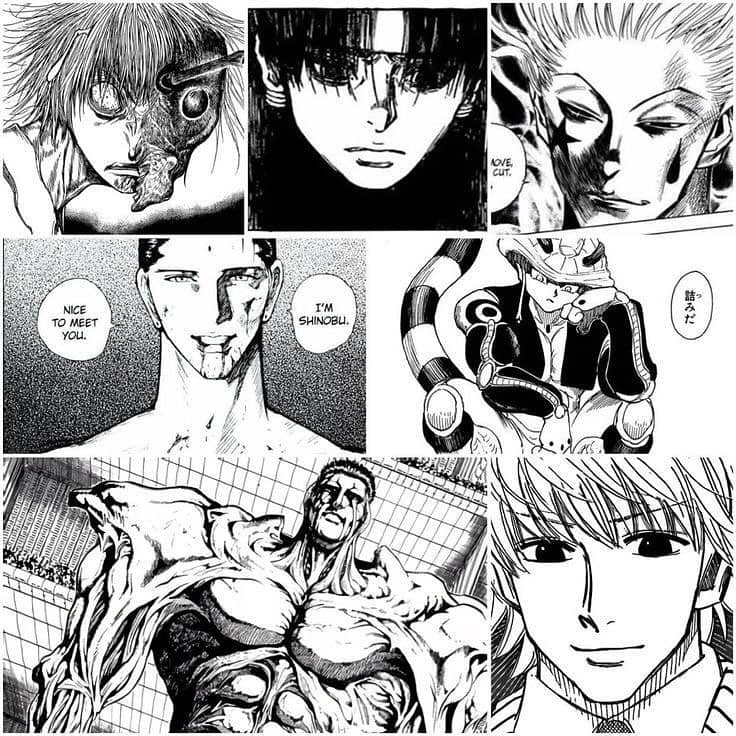
But with the free serialization agreement, something interesting happened.
The Sketchy Chapters
Some of the chapters he officially released were... rough. These were NOT preliminary sketches. These were final copies that were actually published. When these were published, there was a tremendous amount of backlash and criticism for the lack of professionalism.
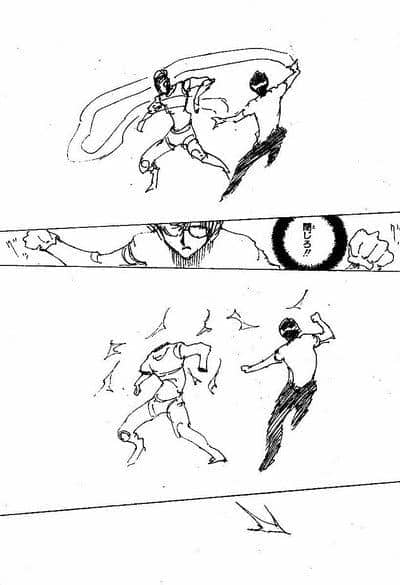
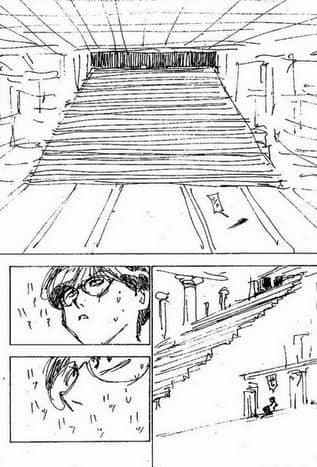
These are NOT preliminary sketches. These are final copies that were actually published.
Even I was like "wtf?" as I was reading it — but the story was so captivating I had no choice but to continue reading. The artist continued to take hiatuses, published more chapters like this, and eventually finished the story arc.
Later on it was revealed that he was going through a tremendous amount of chronic back pain and there was physically no way he could sit and draw with effort. Looking at things from his perspective, he had a choice. Either wait for his chronic back pain to get better (no promises), or publish something and move the story forward. He chose the latter.
The One Punch Man Parallel
Now let me introduce a different Japanese comic: One Punch Man. It's about a superhero who's SO strong, he just needs one punch to end any villain. The original version was drawn by the author himself — and the art was, objectively, terrible. Stick figures, rough lines, barely legible panels.
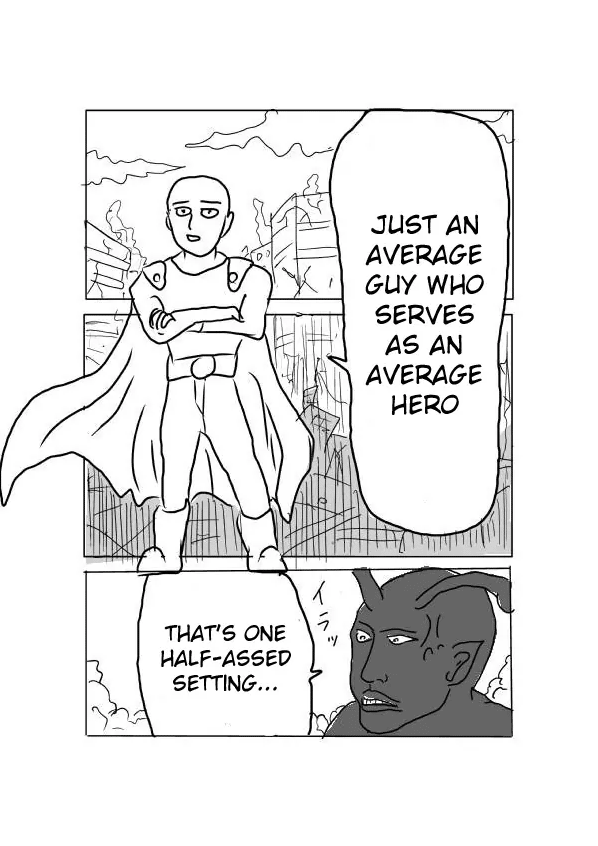
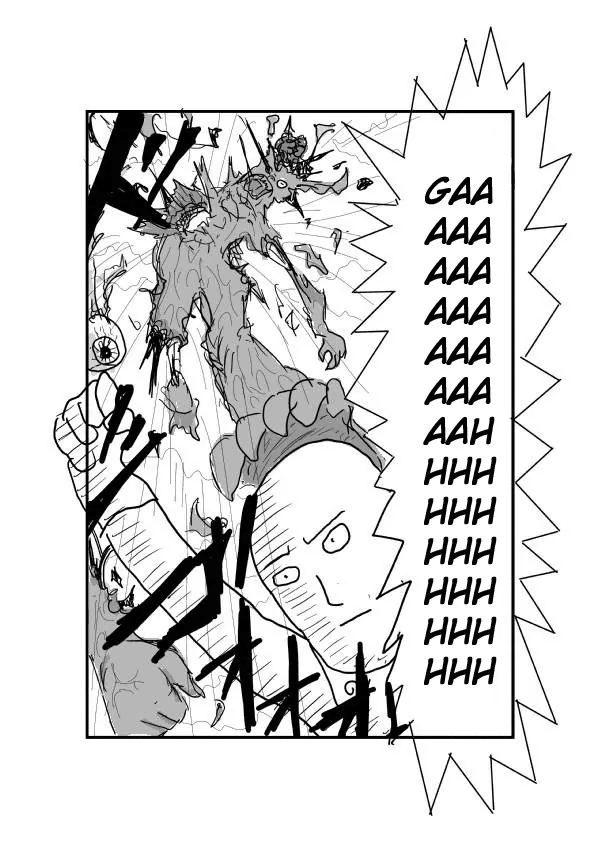
The original One Punch Man artwork. This went on to become one of the most popular manga series in the world.
But the story was so good that it gained a massive following anyway. It eventually got re-made with a professional artist who focuses on the art while the original author exclusively works on the story. So One Punch Man now has the stereotypical "professional" look — but we can't deny that it was possible because the author decided to move the story forward regardless of how it looked.
What This Means for You
I see too often people giving up on doing anything — or outputting anything — because it's not good enough. Too many people wait for the right conditions and they'd rather output nothing than put out something "bad."
Comics are stories told in visual format. It helps if the artwork is great, but because both Togashi and the One Punch Man author knew that what matters is the story, they focused on the essential elements — not the quality of the polish.
In the grand scheme of things, the quality of individual outputs doesn't really matter all that much — as long as you are clear on what is essential to your output. A rough sketch is still a chapter. A terrible first draft is still a draft. A shaky 30-second video is still a video.
The power to create will be equivalent to — or even more valuable than — the power to make money right now. Information generation, when compounded by your life experience, will give you a tremendous amount of self-authority. Regardless of where you are in your life right now, creation is a skill you must take seriously for self-reliance.
Take these examples and give your work an opportunity to exist in the world. Even if it's equivalent to a few squiggly lines in a world full of classical European art.
Even squiggly lines move the story forward.